Share this guide
Help more farmers discover useful tools
Save Time
Instant access
More Benefits
Apply for schemes
Better Decisions
Real-time data
Transparent & Safe
Official platforms
Minimum Support Price (MSP) in India: Crops Covered, CACP Formulas & Government Procurement
The Minimum Support Price (MSP) is a market intervention mechanism established by the Government of India to protect agricultural producers against catastrophic price crashes during bumper harvest years. Fixed on the recommendations of the Commission for Agricultural Costs and Prices (CACP) before the start of each sowing season, MSP acts as a sovereign price benchmark for agricultural commodities. Understanding how MSP is computed, which crops are statutory, and how to register on state procurement portals enables farmers to avoid selling their grain to private traders at steep discounts.
1. The 22 Mandated Crops + Sugarcane Covered Under MSP
The Central Government fixes MSP for 22 mandated agricultural crops across Kharif and Rabi seasons, alongside the Fair and Remunerative Price (FRP) for Sugarcane: | Category | Mandated Crops | |---|---| | Cereals (7 Crops) | Paddy, Wheat, Maize, Sorghum (Jowar), Pearl Millet (Bajra), Barley, Finger Millet (Ragi) | | Pulses (5 Crops) | Gram (Chana), Pigeon Pea (Arhar / Tur), Green Gram (Moong), Black Gram (Urad), Lentil (Masur) | | Oilseeds (8 Crops) | Groundnut, Rapeseed-Mustard, Soybean, Sunflower seed, Sesamum (Til), Safflower, Niger seed, Toria | | Commercial Crops (2 Crops) | Raw Cotton (Medium & Long Staple), Raw Jute, Copra, De-husked Coconut | | Sugarcane (Statutory FRP) | Fixed under the Sugarcane (Control) Order 1966; paid directly by private & cooperative sugar mills |
2. How the CACP Computes MSP: Cost Concepts Explained
The Commission for Agricultural Costs and Prices (CACP) evaluates three distinct cost concepts when estimating the cost of production for each crop:
- Cost A2 (Direct Paid-Out Expenses):
- Sum of all out-of-pocket cash expenditures incurred by the farmer on certified seeds, chemical fertilizers, pesticides, hired human labor, bullock/tractor machine hire charges, diesel, irrigation fees, and land revenue taxes.
- Cost A2 + FL (Paid-Out Costs + Family Labor):
- Cost A2 plus the imputed economic value of unpaid family labor (Family Labor - FL) invested in the field.
- Current Government Formula: Since the Union Budget of 2018–19, the Central Government fixes MSP for all mandated crops at a minimum of 1.5 times (50% profit margin over) the Cost A2 + FL.
- Cost C2 (Comprehensive Cost):
- The holistic cost framework recommended by the National Commission on Farmers headed by Dr. M.S. Swaminathan.
- Includes Cost A2 + FL plus the imputed rental value of owned agricultural land and interest on owned fixed capital assets. Farmers' organizations continue to advocate for fixing MSP at C2 + 50%.
3. Step-by-Step Guide: How Farmers Can Sell Grain at MSP
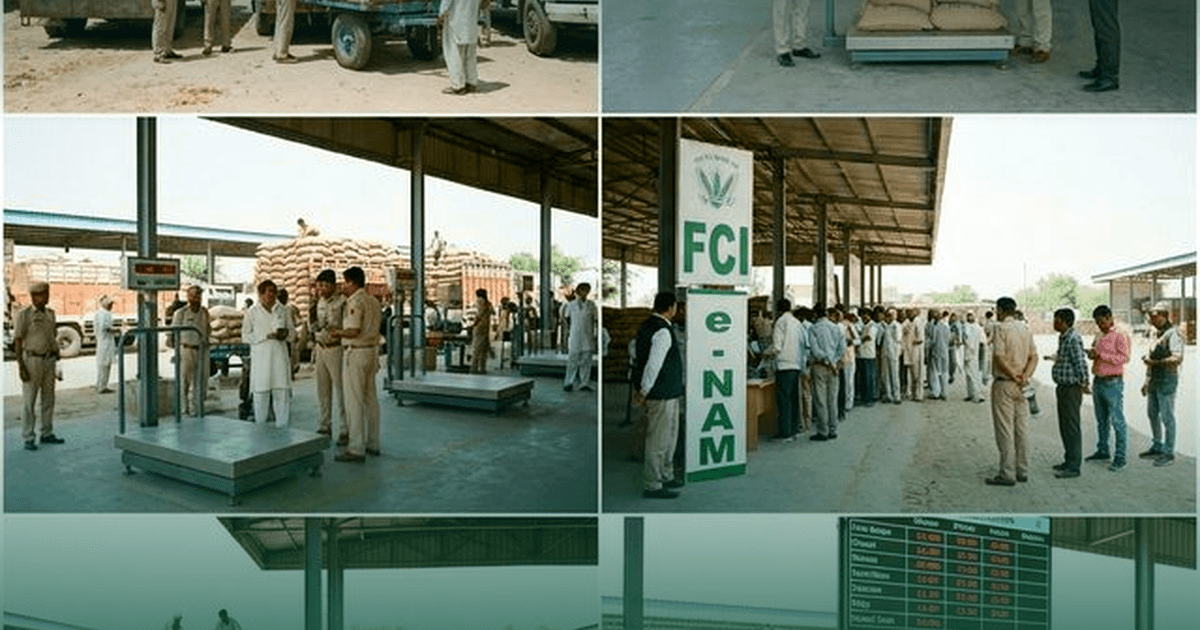
Procurement is executed directly on the ground by central agencies like the Food Corporation of India (FCI), NAFED, and Cotton Corporation of India (CCI) alongside state civil supplies corporations.
Step 1: Pre-Harvest Registration on State e-Procurement Portals * Registration is mandatory 3 to 4 weeks prior to harvest on designated state portals (e.g., e-Uparjan in Madhya Pradesh, Meri Fasal Mera Byora in Haryana, Anaaj Kharid in Punjab, e-Samridhi / NAFED portal for pulses/oilseeds). * Enter land survey numbers, cultivated crop acreage, Aadhaar, and active bank account details.
Step 2: Crop Sowing Verification (Girdawari) * Local revenue officials (Patwari / Talathi) cross-verify the digital crop survey (Pik Pahani / Girdawari) to confirm that the farmer actually cultivated the registered crop on that land parcel.
Step 3: SMS Slot Booking & Delivery * The procurement agency sends an automated SMS with a specific delivery date and designated purchase center (Kharid Kendra). * Deliver grain cleaned to Fair Average Quality (FAQ) standards (e.g., moisture content below 12% for wheat and 17% for paddy).
Step 4: Electronic Assaying & DBT Payment * Grain moisture is verified with digital moisture meters; weight is logged electronically. * Sale proceeds are disbursed directly via DBT into the farmer's bank account within 48 to 72 hours.
Frequently Asked Questions (FAQ)
Q1: What happens if moisture content in my grain exceeds the FAQ limit at the procurement center? If your wheat or paddy exceeds the maximum permissible moisture limit (e.g., 14% for wheat), the center manager can temporarily reject the lot. Farmers are allowed to spread the grain on the mandi drying yards for 1 to 2 sunny days to bring moisture down to FAQ standards before re-submitting for weighment.
Q2: Is private trade below MSP legally punishable in India? Currently, there is no statutory law penalizing private traders for purchasing commodities below MSP in open APMC mandi auctions. MSP is a guaranteed purchase floor administered strictly at official government procurement centers.
Agronomy Tools
Calculate Exact Fertilizer & Input Costs
Use our free agronomy calculators to estimate acreage seed rates, N-P-K dosages, and season profit projections.
K
Written by KhetiSetu Agrarian Economics Desk
Empowering Indian farmers with scientific agronomy, ICAR guidelines, and transparent digital tools.