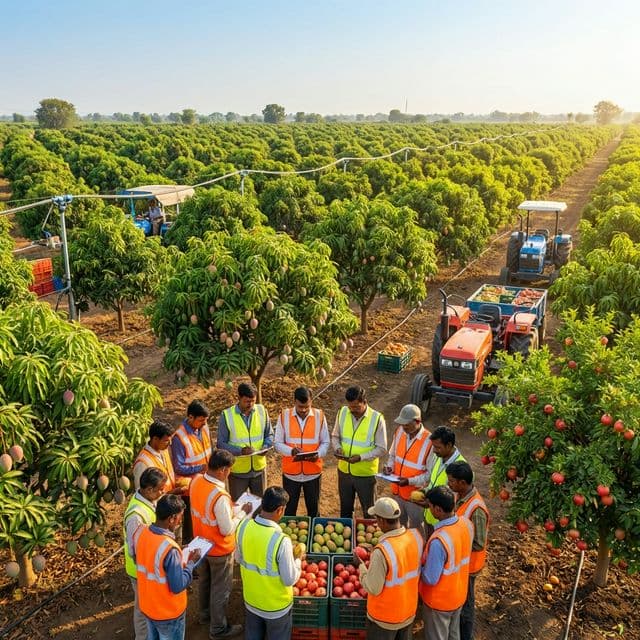
Horticulture Cluster Development Programme (CDP) by NHB
A Central Sector Scheme by the National Horticulture Board that builds integrated infrastructure in 55 identified fruit, vegetable, and spice clusters to boost farmer incomes and exports.
Overview
The Horticulture Cluster Development Programme (CDP) is a Central Sector Scheme launched on 31 May 2021 by the Union Ministry of Agriculture and Farmers' Welfare, implemented through the National Horticulture Board (NHB). Its goal is to achieve holistic, end-to-end development of identified horticulture clusters — regions known for growing a specific high-value fruit, vegetable, or spice crop — so that they become globally competitive in production, post-harvest handling, and export.
A "cluster" is a geographical area already specializing in one focus crop because of soil, climate, or tradition — for example Nashik (Maharashtra) for grapes, Solapur (Maharashtra) and Chitradurga (Karnataka) for pomegranate, or Lucknow (Uttar Pradesh), Kutch (Gujarat) and Mahbubnagar (Telangana) for mango. Rather than funding scattered individual projects, CDP invests in the whole value chain of one cluster at a time: better planting material, modern pack-houses and cold chains, efficient logistics, and branding for export markets.
The Ministry has identified 55 such horticulture clusters across the country, with an initial pilot phase covering 12 clusters. The programme is expected to benefit around 10 lakh farmers and value-chain stakeholders and draw an estimated ₹10,000 crore in investment once rolled out across all identified clusters, with a target of raising exports of cluster crops by roughly 20%.
Revised CDP Guidelines (notified in late 2024 and further updated in 2025) streamlined funding norms and widened the scope to include Peri-Urban Vegetable Clusters and Multi-Commodity High-Tech Horticulture Clusters, alongside the original fruit and plantation-crop clusters.
Key Benefits
- Integrated value-chain investment: Each cluster receives coordinated support across pre-production, production, post-harvest management, logistics, and marketing — not a one-off subsidy for a single input.
- Modern post-harvest infrastructure: Pack-houses, sorting and grading lines, ripening chambers, cold storage, and reefer transport built close to the farm gate to cut spoilage.
- Better price realisation: Collective processing and branding under a cluster-specific identity help farmers get premium prices instead of distress sales to local traders.
- Export readiness: Technical support to meet international quality norms (such as GlobalGAP and residue standards) so that small and marginal farmers' produce becomes export-eligible.
- Financial assistance to implementing agencies: Government/public-sector Cluster Development Agencies (CDAs) can receive assistance of up to 25% of the Focus Crop's Farm Gate Value (FGV), subject to a cap of 50% of the actual project cost, to build shared infrastructure for the cluster.
- FPO-led delivery: Farmer Producer Organisations (FPOs) and Farmer Producer Companies (FPCs) operating within a notified cluster can access the facilities and services created under the project.
Eligibility Criteria
CDP does not work like a typical individual-farmer subsidy scheme; it funds cluster-level infrastructure that farmers in that cluster then use. Eligibility therefore applies at two levels:
- For implementing agencies (Cluster Development Agency/CDA): Must be a Government entity or Public Sector Undertaking recommended by the concerned State Government or a Central Government body, appointed by NHB for a specific notified cluster.
- For FPOs/FPCs and private partners: Registered FPOs, FPCs, cooperatives, or private entities engaged in production, processing, logistics, or marketing of the cluster's focus crop may partner with the CDA to execute specific components (e.g., a pack-house or collection centre) within the approved cluster project.
- For individual farmers: Any farmer cultivating the designated focus crop within a notified cluster area benefits automatically once common infrastructure (nurseries, pack-houses, cold storage, transport) becomes operational; joining a local FPO/FPC active in the cluster is the practical way to access these facilities, training, and market linkages.
- A given crop-geography can be considered a cluster only if it already shows meaningful area, production, and existing market/export potential for that crop, as assessed by NHB and the State Horticulture Department.
Documents Required
Documentation differs by who is engaging with the programme:
For the Cluster Development Agency / Implementing Agency (project-level submission to NHB):
- Detailed Project Report (DPR) for the cluster, prepared in response to NHB's Notice Inviting Proposals / Expression of Interest (EoI).
- State/Central Government recommendation letter nominating the agency as CDA for the cluster.
- Land documents or no-objection certificates for sites proposed for common infrastructure (pack-houses, cold stores, collection centres).
- Baseline data on cluster area, production, yield, and existing market/export linkages for the focus crop.
For FPOs/FPCs and individual farmers wanting to benefit:
- FPO/FPC registration certificate (Companies Act or Cooperative Societies Act, as applicable).
- Proof of land/crop under cultivation within the notified cluster (land records such as 7/12, Khatauni, or equivalent).
- Aadhaar Card and active bank account details for receiving any pass-through benefits or payments routed through the FPO.
- Membership proof of the local FPO/FPC associated with the cluster.
How to Apply
Because CDP operates at the cluster/project level rather than through individual farmer applications, the process works as follows:
- Cluster identification: NHB, in consultation with State Horticulture Departments, identifies and notifies eligible horticulture clusters based on crop concentration, production volume, and export potential.
- Call for proposals: NHB periodically issues a Notice Inviting Proposals/Expression of Interest (EoI) on its dedicated CDP portal for specific clusters, inviting eligible government bodies or public-sector entities to act as the Cluster Development Agency.
- DPR submission and appraisal: The proposed CDA submits a Detailed Project Report; it is examined by NHB's Project Appraisal Committee for technical and financial viability.
- Approval and implementation: On approval, the CDA executes the project — setting up nurseries, pack-houses, cold chain, and market linkages — with NHB providing financial assistance and monitoring progress.
- Farmer/FPO participation: Once the cluster project is operational, farmers in the area join or engage with the local FPO/FPC, which in turn accesses the shared infrastructure, training (GAP/GlobalGAP), and marketing/export linkages created under the programme.
- Updates, EoIs, and application timelines are published on the official CDP portal at cdp.nhb.gov.in; interested government bodies, FPOs, and farmers can also approach their State Horticulture Department or the nearest NHB regional office for the current status of clusters in their area.
Important Points
- CDP is not a direct cash subsidy to individual farmers; it funds shared, cluster-level infrastructure and market linkages that farmers access collectively, typically through an FPO.
- Clusters are categorised as Mega (assistance up to ₹100 crore), Midi (up to ₹50 crore), or Mini (up to ₹25 crore) based on scale, under the programme's funding norms.
- NHB retains a small share of the approved assistance (up to 5% for administrative/PMU costs and up to 2% for contractual staff salaries) to run the State Horticulture Mission/CDP management structure.
- The scope now also covers Peri-Urban Vegetable Clusters and Multi-Commodity High-Tech Horticulture Clusters under the revised guidelines, not just traditional fruit clusters.
- Farmers interested in participating should actively engage with their local FPO/FPC and State Horticulture Department, since on-ground delivery depends on the CDA executing the sanctioned cluster project in their area.
- Always verify current EoIs, guidelines, and cluster status directly on cdp.nhb.gov.in, as cluster selection and funding windows are updated periodically.
Frequently Asked Questions (FAQs)
What exactly is a horticulture cluster under CDP?
A cluster is a geographically concentrated area that already grows one specific high-value horticulture crop (such as mango, grapes, pomegranate, or a vegetable) at scale due to favourable agro-climatic conditions, and is notified by NHB/the State Government for integrated, end-to-end development under the programme.
Can an individual farmer apply directly to NHB for CDP benefits?
No. CDP funds are released to a Cluster Development Agency (a government or public-sector entity) for building shared infrastructure in a notified cluster. Individual farmers benefit by being part of that cluster and, in practice, by joining the local FPO/FPC that engages with the project.
Which crops are currently covered under CDP's pilot clusters?
The pilot phase includes clusters such as mango (Lucknow in Uttar Pradesh, Kutch in Gujarat, Mahbubnagar in Telangana), grapes (Nashik in Maharashtra), and pomegranate (Solapur in Maharashtra, Chitradurga in Karnataka), with the programme ultimately envisaged to cover 55 identified clusters across various fruits, vegetables, and plantation crops.
How much financial assistance does a cluster project get?
Implementing agencies can receive assistance of up to 25% of the Farm Gate Value of the focus crop, capped at 50% of the actual project cost, with clusters classified as Mega (up to ₹100 crore), Midi (up to ₹50 crore), or Mini (up to ₹25 crore) depending on scale.
Who can become a Cluster Development Agency (CDA)?
A Government department or Public Sector Undertaking recommended by the State Government or a Central Government body, and formally appointed by NHB, can act as the CDA responsible for implementing a specific notified cluster's project.
What kind of infrastructure does CDP typically fund?
Common nurseries and quality planting material, pack-houses, sorting and grading units, cold storage and ripening chambers, refrigerated transport, and market/export facilitation and branding support for the cluster's focus crop.
Is CDP only for export-oriented crops?
No. While improving exports is a key objective, CDP also targets reducing post-harvest losses and improving domestic price realisation for farmers, including through the newer Peri-Urban Vegetable Cluster component aimed at better supply to nearby urban markets.
Where can I check the latest CDP clusters, guidelines, and proposals?
The dedicated CDP portal, cdp.nhb.gov.in, maintained by the National Horticulture Board, publishes the current list of notified clusters, revised guidelines, and active Notices Inviting Proposals/EoIs; State Horticulture Departments and NHB regional offices can also provide local updates.