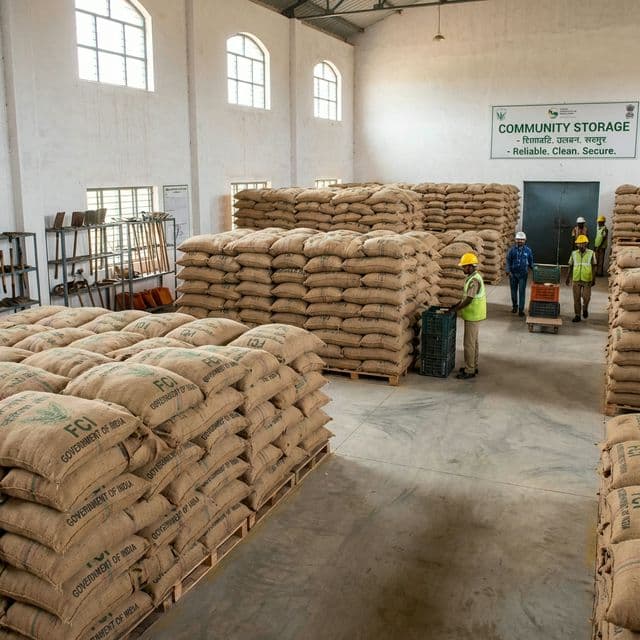
Gramin Bhandaran Yojana - Rural Godown Storage Subsidy (AMI)
Capital subsidy (25-33.33%) for rural godown construction under the AMI/ISAM scheme - cuts post-harvest loss, enables warehouse-receipt pledge loans for farmers.
Overview
The Gramin Bhandaran Yojana (Rural Godown Scheme) was launched by the Government of India on 1 April 2001 to build scientific storage infrastructure in rural areas so that farmers are not forced into distress sales right after harvest. Since 1 April 2014, the scheme has been merged into the Agricultural Marketing Infrastructure (AMI) sub-scheme of the Integrated Scheme for Agricultural Marketing (ISAM), administered by the Directorate of Marketing & Inspection (DMI) under the Department of Agriculture and Farmers Welfare, Ministry of Agriculture and Farmers Welfare. The AMI sub-scheme (and the ISAM umbrella it sits under) has been extended up to 31 March 2026.
The capital investment subsidy is credit-linked and back-ended: an applicant first arranges term finance from a scheduled commercial bank, regional rural bank, state/urban cooperative bank, NABARD, or the National Cooperative Development Corporation (NCDC), and the subsidy is released after the godown is built and jointly inspected. The goal remains the same as under the original Gramin Bhandaran Yojana — reduce post-harvest losses, support scientific grading and standardisation of produce, and let farmers borrow against stored stock using Negotiable Warehouse Receipts (NWRs) instead of selling immediately at low post-harvest prices.
Key Benefits
- Capital subsidy for construction/renovation: Back-ended subsidy on the capital cost of building a new godown or renovating an existing one.
- Higher subsidy for priority categories: Women farmers, Scheduled Caste/Scheduled Tribe entrepreneurs, their cooperatives, Farmer Producer Organisations (FPOs) and Panchayats are eligible for 33.33% of the project's capital cost, while general-category individuals, partnerships, companies and corporations are eligible for 25% of the capital cost — both are subject to project-specific ceilings notified under the current AMI guidelines.
- Special treatment for difficult terrain: Projects in the North-Eastern States, Sikkim, the Andaman & Nicobar Islands, Lakshadweep, and other hilly/notified areas qualify for the higher 33.33% subsidy slab with a correspondingly higher ceiling.
- Flexible project size: The scheme supports rural godowns across a wide capacity range, from smaller farmer-level units up to large warehouses of several thousand tonnes.
- Pledge financing through NWRs: Godowns built to scientific-storage standards can be registered under the Warehousing (Development and Regulation) Act, 2007, enabling farmers to obtain Negotiable Warehouse Receipts (including electronic NWRs) and raise loans against stored produce without an immediate distress sale.
- Grading and standardisation support: The scheme encourages proper grading, weighment and quality assessment of stored produce, improving the price farmers eventually realise.
- Reduced post-harvest losses: Scientific storage cuts down losses caused by moisture, rodents, pests and poor handling, which otherwise erode farm income significantly.
Eligibility Criteria
The following categories can apply for assistance under the AMI sub-scheme for rural godowns:
- Individual farmers, groups of farmers and growers
- Farmer Producer Organisations/Companies (FPOs/FPCs) registered under the relevant Companies Act, Cooperative Societies Act, or Societies Registration Act, generally with a minimum prescribed number of farmer-members
- Partnership and proprietorship firms, private and public limited companies, and corporations
- Non-Governmental Organisations (NGOs) and Self-Help Groups (SHGs)
- Cooperatives, cooperative marketing federations, and state/central warehousing corporations
- Agricultural Produce Marketing Committees (APMCs), state agricultural marketing boards, and local bodies such as Panchayats
- Any entrepreneur or entity intending to build or renovate a scientific storage structure for agricultural commodities, located outside municipal corporation limits as per scheme norms
Applicants claiming the higher 33.33% subsidy slab (women, SC/ST entrepreneurs or their cooperatives/SHGs, FPOs, Panchayats) must furnish supporting category certificates/registration proof at the time of application.
Documents Required
- Detailed Project Report (DPR) with cost estimate, prepared/endorsed by a qualified engineer or architect
- Proof of land ownership or a valid long-term lease deed for the project site
- Identity and address proof of the applicant (Aadhaar, PAN, voter ID, etc.)
- Registration certificate for FPOs, cooperatives, companies, NGOs or SHGs, as applicable
- Caste certificate, where the applicant is claiming the SC/ST subsidy category
- Bank account details and term-loan sanction letter from the financing bank/institution
- No-objection certificate from the local authority/Gram Panchayat, confirming the site is outside municipal limits (where applicable)
- Site photographs and a layout plan of the proposed/renovated godown
How to Apply
- Prepare a Detailed Project Report (DPR) covering the proposed storage capacity, site details, construction cost, and the subsidy category being claimed.
- Approach a financing institution — a scheduled commercial bank, regional rural bank, state/urban cooperative bank, or apply through NABARD/NCDC channels — with the DPR and required documents to secure term finance for the project.
- Get the project sanctioned: The bank appraises the project, sanctions the term loan, and forwards the subsidy claim through the applicable nodal/refinancing agency (NABARD for most categories; NCDC for cooperative-sector projects) as per AMI/ISAM guidelines.
- Construct the godown to scientific storage specifications within the sanctioned timeline.
- Joint inspection: On completion, a joint inspection committee verifies the constructed/renovated godown against the sanctioned DPR.
- Subsidy release: Once verification is complete, the back-ended capital subsidy is credited, typically adjusted against the outstanding term loan.
- Register for warehouse receipts (optional but recommended): Once operational, the godown can be registered with the Warehousing Development and Regulatory Authority (WDRA) to issue Negotiable Warehouse Receipts, enabling pledge finance for depositors.
Because implementation details (forms, portals, and empanelled banks) can change with each guideline revision, applicants should always confirm the latest process with their nearest NABARD district office, financing bank, or the DMI/Department of Agriculture and Farmers Welfare before starting construction.
Important Points
- The scheme is now formally the Agricultural Marketing Infrastructure (AMI) sub-scheme under ISAM; "Gramin Bhandaran Yojana" is its well-known legacy name and is still widely used.
- The subsidy is back-ended and credit-linked — it is released only after the project is completed and verified, not in advance.
- Godowns should generally be located outside municipal corporation limits and must follow scientific storage specifications so they can later be registered for warehouse-receipt financing.
- Subsidy percentages (25%/33.33%) and ceiling amounts are periodically revised through government notifications; always verify the current ceiling before finalising a project budget.
- The AMI sub-scheme/ISAM has been extended up to 31 March 2026; applicants should check for further extensions or revisions beyond that date.
- NABARD acts mainly as a refinancing/nodal agency for commercial and cooperative bank loans under this scheme — it is not necessarily the only financing channel, and NCDC plays a similar role for cooperative-sector projects.
Frequently Asked Questions (FAQs)
Is Gramin Bhandaran Yojana a separate, standalone scheme today?
Not administratively. Since 1 April 2014 it has been merged into the Agricultural Marketing Infrastructure (AMI) sub-scheme of the Integrated Scheme for Agricultural Marketing (ISAM). "Gramin Bhandaran Yojana" remains the commonly used name for the rural-godown component of AMI.
What subsidy percentage can I expect?
Women farmers, SC/ST entrepreneurs and their cooperatives/SHGs, FPOs and Panchayats are generally eligible for 33.33% of the project's capital cost; general-category applicants (individuals, partnerships, companies) are generally eligible for 25%. Both rates are subject to ceiling limits that are revised from time to time, so confirm the current figures with your bank or NABARD before applying.
Is the subsidy paid upfront or after construction?
It is back-ended and credit-linked — you must first secure a term loan and build the godown; the subsidy is released only after the project is completed and jointly inspected, and is usually adjusted against the loan.
Who implements the scheme today — NABARD or the Ministry of Agriculture?
Policy and guidelines are issued by the Directorate of Marketing & Inspection (DMI) under the Ministry of Agriculture and Farmers Welfare (the AMI sub-scheme owner). NABARD and NCDC act as refinancing/nodal agencies that route subsidy claims through banks and cooperative institutions.
Can a landless agri-entrepreneur apply, not just a landowning farmer?
Yes. Partnership/proprietorship firms, companies, NGOs, SHGs, cooperatives and FPOs can apply, provided they hold valid ownership or a long-term lease on the project land and meet the other eligibility conditions.
What is pledge financing using a warehouse receipt?
Once a godown meets scientific storage norms, it can be registered under the Warehousing (Development and Regulation) Act, 2007 to issue Negotiable Warehouse Receipts (NWRs), including electronic NWRs. A depositor can use this receipt as collateral to borrow from banks against the stored produce instead of selling it immediately at low post-harvest prices.
Is there a minimum or maximum storage capacity for the godown?
Yes, the scheme specifies minimum and maximum storage-capacity limits for an eligible project, and these thresholds have been revised over the years. Check the latest AMI operational guidelines or consult your financing bank for the capacity range currently applicable to your category of applicant.
Where can I find the latest official guidelines?
The Directorate of Marketing & Inspection publishes current AMI/ISAM operational guidelines, subsidy ceilings and application procedures; applicants should always cross-check details with DMI, NABARD, or their financing bank before finalising a project, since figures are periodically revised.