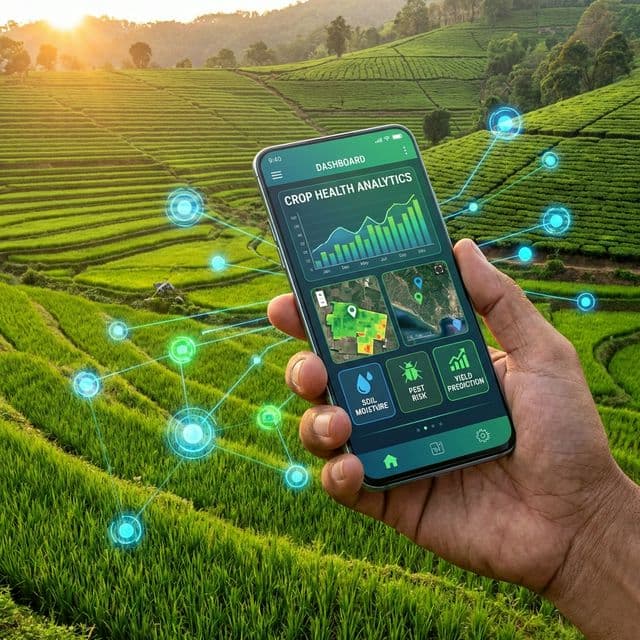
Digital Agriculture Mission (DAM) – Farmer ID & AgriStack
Rs. 2,817-crore scheme building AgriStack, giving every farmer a digital Farmer ID linked to land records, crops sown, and government scheme benefits.
Overview
The Digital Agriculture Mission (DAM) is a central sector scheme approved by the Union Cabinet on 2 September 2024 with a total outlay of ₹2,817 crore, including a central share of about ₹1,940 crore, implemented by the Ministry of Agriculture and Farmers Welfare. It is built on two pillars — AgriStack and the Krishi Decision Support System (KDSS) — that together create a Digital Public Infrastructure (DPI) for Indian agriculture.
Under AgriStack, every farmer is issued a unique Farmer ID (Kisan Pehchaan Patra), similar in spirit to Aadhaar, that is dynamically linked to the farmer's land records, crops sown, livestock, demographic details, and the government benefits they already receive. This is combined with a Digital Crop Survey (Crop Sown Registry) and Geo-Referenced Village Maps, so that crop-wise, plot-wise data is available in near real time.
As of August 2026, more than 10.31 crore Farmer IDs have been created across the country, and the Digital Crop Survey has been conducted in 648 districts, covering over 31.3 crore plots during Rabi 2025–26 — moving the Mission toward its goal of roughly 11 crore (110 million) Farmer IDs by 2026–27.
Key Benefits
- Farmer ID (Kisan Pehchaan Patra): A single digital identity that works across central and state schemes, so farmers no longer need to submit the same land and identity documents repeatedly.
- AgriStack Farmer Registry: A unified, state-maintained database linking land ownership records, crop history, and benefit history to each farmer.
- Digital Crop Survey: Geo-tagged, plot-level crop data that improves accuracy in yield estimation, crop insurance (PMFBY) settlement, and Minimum Support Price (MSP) procurement.
- Krishi Decision Support System (KDSS): Satellite imagery, AI, and remote-sensing-based advisories on irrigation scheduling, fertiliser use, pest alerts, and weather risk.
- Faster, leakage-free scheme delivery: Verification for PM-KISAN instalments, PMFBY claims, and Kisan Credit Card (KCC) applications is increasingly linked to the Farmer ID, reducing duplicate and fraudulent claims.
- Easier access to institutional credit: Digitally verified land and crop records help banks assess a farmer's eligibility for crop loans faster.
- Geo-Referenced Village Maps: Digitised land-parcel maps that support better planning for irrigation, drainage, and rural infrastructure.
Eligibility Criteria
- Any landholding farmer in a state or Union Territory that has rolled out the AgriStack Farmer Registry is eligible to obtain a Farmer ID.
- The applicant must have a valid Aadhaar number with a mobile number linked to it for OTP-based verification.
- Land records (individual or joint family holding) must be traceable in the state's land revenue records (Khasra/Khatauni, 7/12 extract, Jamabandi, or Record of Rights, depending on the state).
- Tenant and sharecropper farmers can be included in several states through the local land-record or crop-registration process, where such provisions exist.
- There is no income, caste, or landholding-size restriction for creating a Farmer ID itself — it is a digital registry, not a direct cash-benefit scheme — but the ID is increasingly required as a prerequisite to access other subsidy and credit schemes.
Documents Required
- Aadhaar card, with a mobile number linked to Aadhaar for OTP verification.
- Land record document relevant to your state (Khasra/Khatauni, 7/12 extract, Jamabandi, or Record of Rights).
- Passport-size photograph (where registration is done at a camp or Common Service Centre).
- Bank account passbook or cancelled cheque, for linking benefit disbursal.
- An active mobile number for OTP-based e-KYC.
How to Apply
- Find your state's Farmer Registry portal: Visit agristack.gov.in and select your state, or go directly to your state's portal (for example, UPFR for Uttar Pradesh, MHFR for Maharashtra, MPFR for Madhya Pradesh, or BHFR for Bihar).
- Self-registration: Log in with your Aadhaar number, verify with the OTP sent to your Aadhaar-linked mobile, and enter your district, tehsil/taluka, village, and Khasra/Khata number to map your landholding.
- Assisted registration: Visit a village-level special camp, a Common Service Centre (CSC), or approach the local Patwari, Krishi Sahayak, or agriculture extension officer, who can complete the e-KYC and land-linking process on your behalf.
- Verification: The details you submit are cross-checked against the state's digital land records.
- Farmer ID generation: Once verified, a unique Farmer ID is generated, which you can download or print from the portal.
- Keep details updated: Update your Farmer ID record whenever your landholding, bank account, or mobile number changes.
Important Points
- Registration for a Farmer ID under AgriStack is completely free — be cautious of anyone asking for payment.
- Several states have started making the Farmer ID a prerequisite for receiving PM-KISAN instalments, PMFBY claim settlements, and new KCC loans from the 2025–26 cycle onward, so farmers should register as early as possible.
- AgriStack data is governed by a consent-based framework; farmers should verify what data is being shared and with whom before confirming registration.
- Rollout status (which districts/villages are covered) differs by state — check your state's farmer registry portal or local agriculture office for the current schedule in your area.
- Keep your Aadhaar-linked mobile number active, since most verification steps rely on OTP delivered to that number.
Frequently Asked Questions (FAQs)
What is a Farmer ID under the Digital Agriculture Mission?
A Farmer ID (also called Kisan Pehchaan Patra) is a unique digital identification number created under AgriStack that links a farmer's identity to their land records, crops sown, and the government benefits they have received, so that services can be delivered faster and more accurately.
Is there any fee to register for a Farmer ID?
No. Registration on the official AgriStack Farmer Registry portal, at government camps, or through a Common Service Centre is completely free of cost.
What are AgriStack and the Krishi Decision Support System?
AgriStack is the Digital Public Infrastructure that includes the Farmer Registry, Geo-Referenced Village Maps, and the Digital Crop Survey (Crop Sown Registry). The Krishi Decision Support System (KDSS) uses satellite data, AI, and remote sensing to generate real-time advisories and decision-support tools for farmers and policymakers.
Will I lose my PM-KISAN or PMFBY benefits if I don't create a Farmer ID?
Several states are progressively linking Farmer ID with PM-KISAN instalments, PMFBY crop insurance claims, and KCC loan applications. While timelines vary by state, it is advisable to register early to avoid any delay or disruption in receiving these benefits.
How do I check which land records are linked to my Farmer ID?
You can log in to your state's Farmer Registry portal (accessible through agristack.gov.in) using your Aadhaar-linked mobile number and OTP to view the Khasra/Khatauni or 7/12 land details mapped to your Farmer ID.
Can tenant farmers or sharecroppers get a Farmer ID?
In states where the local land-record system recognises tenancy or crop-sharing arrangements, such farmers may be registered through the applicable local process; eligibility depends on your state's specific AgriStack implementation rules.
What happens during the Digital Crop Survey?
Trained enumerators, often with the help of a mobile app, record geo-tagged, plot-level details of the crop sown on each field during a season. This Crop Sown Registry data improves the accuracy of yield estimates, insurance claim settlement, and MSP procurement planning.
Where can I get help if my Farmer ID registration fails or my land details are incorrect?
You can approach your village-level special camp, the nearest Common Service Centre (CSC), or the local agriculture/revenue department office, who can help correct land-record mismatches and resubmit your Farmer ID application.