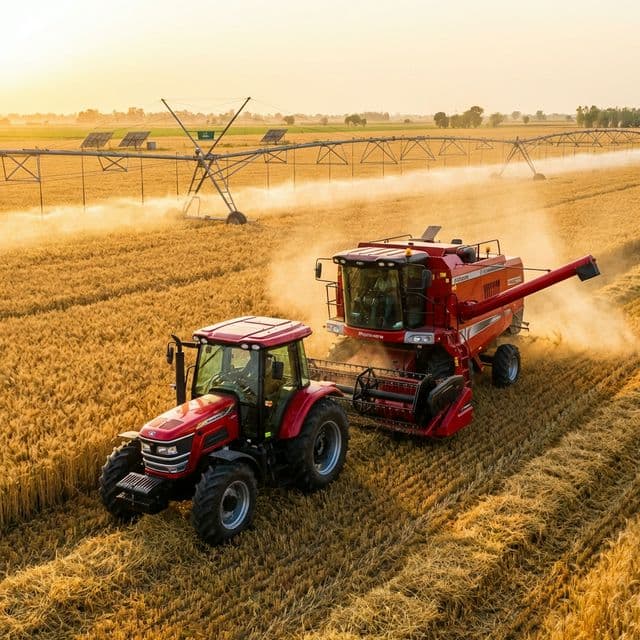
SMAM Scheme: Subsidy on Farm Machinery & Tractors in India
SMAM gives up to 50% subsidy on tractors, power tillers, harvesters, Custom Hiring Centres, and Kisan Drones for small, marginal, women, and SC/ST farmers in India.
Overview
The Sub-Mission on Agricultural Mechanization (SMAM) is a central sector scheme run by the Ministry of Agriculture and Farmers Welfare, implemented as part of the Krishonnati Yojana (Green Revolution umbrella scheme) along with State Agriculture/Horticulture Departments. Launched in 2014-15, SMAM was designed on the principle of "reaching the unreached" — taking farm mechanization to small and marginal farmers and to regions, especially the North-East and hilly states, where tractor and implement penetration has historically been low. Since its launch, the scheme has provided an estimated ₹9,400+ crore in central assistance and helped distribute over 21 lakh subsidized machines to individual farmers, besides setting up tens of thousands of Custom Hiring Centres (CHCs) across the country.
SMAM works through four main pillars: (1) direct subsidy to individual farmers for purchasing tractors, power tillers, combine harvesters, and other implements; (2) support for setting up Custom Hiring Centres (CHCs) and Farm Machinery Banks (FMBs) so that farmers who cannot afford to buy expensive machinery can rent it locally; (3) promotion of high-tech, high-productivity equipment hubs; and (4) testing, certification, and training to ensure machines sold in the market meet quality standards and farmers know how to use and maintain them safely.
Key Benefits
- Subsidy on individual machinery: Small and marginal farmers, women farmers, and farmers from SC/ST categories can get up to 50% subsidy on the cost of tractors, power tillers, rotavators, seed drills, combine harvesters, and other notified implements. General category farmers are eligible for 40% subsidy.
- Enhanced support in the North-East and hilly states: Farmers in these regions can receive subsidy up to 100% on small machinery and significantly higher support for setting up Farm Machinery Banks, recognising the higher cost of farm operations in difficult terrain.
- Custom Hiring Centres (CHCs): Entrepreneurs, Farmer Producer Organisations (FPOs), and Self-Help Groups (SHGs) can set up CHCs with project costs of up to ₹60 lakh, receiving 40% subsidy (50% in the North-East/hilly areas) to stock a range of machinery that is rented out to farmers in the village.
- Farm Machinery Banks (FMBs): Groups of farmers, especially through FPOs and SHGs, can access support of up to ₹10 lakh per group to build a shared pool of machinery for local use.
- Drone and high-tech equipment support: Kisan Drones used for spraying fertilizers and pesticides are supported with subsidy up to ₹10 lakh for Krishi Vigyan Kendras (KVKs), ICAR institutes, and State Agricultural Universities, and up to 75% for FPOs; custom-hired drone services through CHCs/FPOs/SHGs are also incentivised at a per-hectare rate for farmers.
- Special focus on women: At least 30% of the scheme's funds are earmarked for the participation of women farmers, encouraging them to adopt mechanized tools that reduce drudgery.
- Direct Benefit Transfer (DBT): Subsidy is credited directly to the farmer's Aadhaar-linked bank account after physical verification and, in many cases, geo-tagging of the purchased machine.
Eligibility Criteria
- The applicant must be an Indian farmer, Farmer Producer Organisation (FPO), Self-Help Group (SHG), cooperative society, or registered rural entrepreneur, depending on the component applied for.
- For individual machinery subsidy, the applicant should hold valid land records (ownership or lease/tenancy as permitted by the state) and an active Aadhaar-linked bank account.
- Small and marginal farmers (landholding up to 2 hectares), women farmers, and SC/ST farmers are given priority and higher subsidy rates.
- Most states require that the applicant has not availed a subsidy on the same category of machine in the preceding several years, to prevent duplicate benefit.
- For a Custom Hiring Centre or Farm Machinery Bank, the applicant group (FPO/SHG/cooperative/individual entrepreneur) must submit a viable business/project plan for the proposed centre.
- Specific horsepower, implement type, and quantity ceilings per farmer/beneficiary are notified each year and may vary slightly by state.
Documents Required
- Aadhaar Card (mandatory, linked to bank account).
- Land ownership or tenancy proof (7/12 extract, Khatauni, Jamabandi, or equivalent state land record).
- Bank passbook or cancelled cheque showing IFSC code, for Direct Benefit Transfer.
- Caste certificate, for applicants claiming SC/ST category benefit.
- Passport-size photograph and valid mobile number linked to Aadhaar.
- Quotation or proforma invoice from an authorized dealer for the machine being purchased.
- For CHC/FMB applications: registration certificate of the FPO/SHG/cooperative and a detailed project proposal.
How to Apply
- Visit the official portal: Applications for SMAM are routed through the Department of Agriculture and Farmers Welfare's farm mechanization portal, farmech.dac.gov.in, or the respective state's DBT-in-Agriculture portal (for example, MahaDBT in Maharashtra, Agriculture Department portals in UP, Bihar's OFMAS, and similar systems in other states).
- Register as a farmer: Create a profile using your Aadhaar number, mobile OTP verification, and basic land and bank details.
- Select the scheme component: Choose the relevant sub-component — individual tractor/implement subsidy, Custom Hiring Centre, Farm Machinery Bank, or Kisan Drone support — under SMAM.
- Upload documents: Submit scanned copies of land records, caste certificate (if applicable), bank details, and the dealer's quotation for the machine.
- Selection process: In states where demand exceeds the sanctioned target, beneficiaries are selected through a transparent computerized draw/lottery; otherwise applications are processed on a first-come-first-served or merit basis as per state guidelines.
- Purchase and verification: After receiving pre-sanction approval, purchase the machine from an authorized dealer. The District Agriculture/Agricultural Engineering Officer will physically verify the machine and, for tractors and major equipment, complete geo-tagging.
- Subsidy disbursal: Once verification is complete, the subsidy amount is credited directly to the farmer's bank account through DBT, typically within four to six weeks.
Important Points
- Subsidy rates, machine-wise cost norms, and the list of eligible implements are revised periodically — always check the current year's operational guidelines on the official portal or with the District Agriculture Office before applying.
- A farmer or farming family is generally permitted only one subsidized unit of a given machine category within a defined cooling-off period to prevent misuse.
- CHC and FMB beneficiaries are encouraged to prioritize custom-hiring services for small and marginal farmers in their village, which is also factored into project approval.
- Farmers should buy only CMVR-certified/tested machines from dealers empanelled with the state agriculture department to remain eligible for subsidy and after-sales support.
- Because mechanization schemes are implemented jointly by the Centre and states, exact subsidy percentages, application windows, and the online portal used can differ from state to state — always confirm details with your local Krishi Vibhag office.
Frequently Asked Questions (FAQs)
What is the Sub-Mission on Agricultural Mechanization (SMAM)?
SMAM is a central government scheme under the Ministry of Agriculture and Farmers Welfare that provides subsidies and support to farmers, FPOs, and entrepreneurs for buying farm machinery, setting up custom hiring centres, and promoting mechanization in regions with low farm power availability.
How much subsidy can I get under SMAM?
Small and marginal farmers, women, and SC/ST farmers can generally receive up to 50% subsidy on eligible machinery, while other farmers receive around 40%. Farmers in the North-East and hilly states may receive higher rates, and specific percentages can vary by machine type and state guidelines.
Who is eligible to apply for SMAM benefits?
Any Indian farmer with valid land records and an Aadhaar-linked bank account can apply for individual machinery subsidy. FPOs, Self-Help Groups, cooperatives, and rural entrepreneurs can apply to set up Custom Hiring Centres or Farm Machinery Banks.
Where do I apply for the SMAM subsidy?
Applications are made through the central farm mechanization portal, farmech.dac.gov.in, or your state's dedicated agriculture DBT portal. Many states also allow applications or guidance through the nearest District Agriculture Office or Krishi Vigyan Kendra.
Can landless farmers or tenant farmers benefit from SMAM?
Direct individual machinery subsidy usually requires proof of land ownership or recognized tenancy. However, landless and tenant farmers can benefit by joining a Custom Hiring Centre, Farm Machinery Bank, or an FPO/SHG group, which lets them access machinery on rent at subsidized rates without needing to own land.
What is a Custom Hiring Centre (CHC) and how can I set one up?
A CHC is a facility that stocks a range of farm machinery which is rented out to farmers in the area, reducing the need for individual ownership of expensive equipment. Entrepreneurs, FPOs, SHGs, and cooperatives can apply with a project proposal of up to ₹60 lakh and receive 40-50% subsidy on the project cost, depending on the region.
Does SMAM support drones for farming?
Yes. SMAM supports the adoption of Kisan Drones for spraying fertilizers, pesticides, and nutrients, with subsidy support for KVKs, ICAR institutes, State Agricultural Universities, FPOs, and custom-hiring service providers, in line with the government's broader push for drone-based precision agriculture.
How is the subsidy amount paid to the farmer?
The subsidy is paid through Direct Benefit Transfer (DBT) directly into the farmer's Aadhaar-linked bank account, after the purchased machine is physically verified (and geo-tagged, where applicable) by the concerned agriculture department official.