Share this guide
Help more farmers discover useful tools
Save Time
Instant access
More Benefits
Apply for schemes
Better Decisions
Real-time data
Transparent & Safe
Official platforms
Women in Indian Agriculture: Legal Rights, Subsidies, Land Titling & Enterprise Schemes
Women are the undisputed bedrock of Indian rural food systems. According to government labor surveys, over 73% of rural women workers are engaged in agriculture, performing over 80% of manual transplanting, weeding, harvesting, and livestock milking operations. Yet, due to entrenched patriarchal inheritance conventions, less than 14% of agricultural land titles in India are held by women. Without land titles in their name, women cultivators are frequently denied institutional bank credit, disaster relief compensation, and government fertilizer subsidies. This guide provides a comprehensive overview of women's statutory land inheritance rights, specialized government support programs, and preferential subsidy allocations.
1. Legal Land Titling & Inheritance Rights for Women
The Hindu Succession (Amendment) Act, 2005: Prior to 2005, daughters in most Indian states were excluded from inheriting agricultural coparcenary land. The landmark 2005 amendment revolutionized rural property law: * Absolute Equal Coparcenary Status: Under Section 6, daughters (whether married or unmarried) possess identical coparcenary rights by birth in ancestral agricultural land, equal to sons. * Supreme Court Affirmation (Vineeta Sharma vs. Rakesh Sharma, 2020): The Supreme Court ruled that daughters inherit ancestral land rights retrospectively, irrespective of whether the father was alive when the 2005 amendment was enacted.
Stamp Duty Concessions for Joint Titling: To incentivize families to register agricultural land and rural homes in women's names, multiple state governments provide substantial financial incentives: * Uttar Pradesh, Maharashtra, Haryana, Delhi: Offer a 1% to 2% reduction in property registration stamp duty when agricultural land or residential property is registered in a woman's name or under joint spousal ownership (Joint 7/12 / Co-Khata).
2. Flagship Government Schemes for Women Cultivators
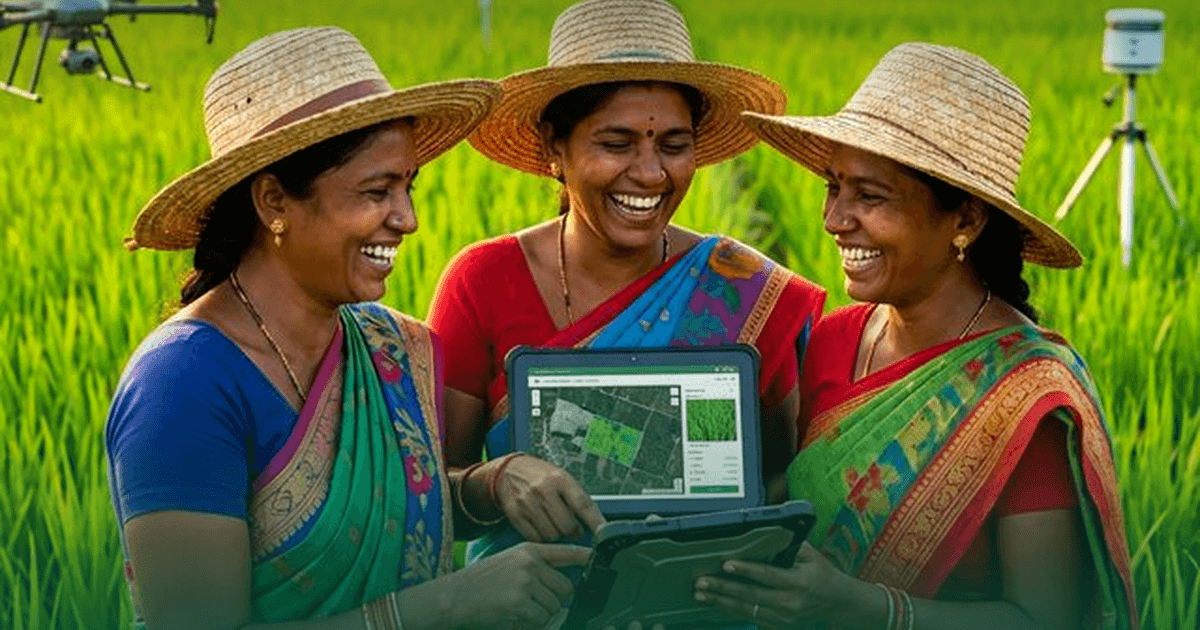
| Scheme Name | Administered By | Core Financial Support & Benefits | |---|---|---| | Namo Drone Didi Scheme | Ministry of Chemicals & Fertilizers / Dept of Agriculture | Provides 15,000 agricultural drones free of cost to women Self-Help Groups (SHGs), complete with 15-day certified DGCA pilot training and a monthly honorarium of ₹15,000 for renting drone spraying services to local farmers. | | Lakhpati Didi Mission | Ministry of Rural Development (DAY-NRLM) | Comprehensive enterprise incubation to ensure at least 3 crore rural SHG women earn a minimum net annual income of ₹1,00,000 through micro-enterprises. | | Mahila Kisan Sashaktikaran Pariyojana (MKSP) | Ministry of Rural Development | Dedicated program promoting agro-ecology, indigenous seed banks, and climate-resilient sustainable agriculture tailored for smallholder women. | | Preferential Mechanization Quotas (SMAM) | Ministry of Agriculture | Central schemes mandate that minimum 30% of total farm mechanization and tractor subsidy funds must be reserved exclusively for women farmers, offering an enhanced 50% subsidy (compared to 40% for general male applicants). |
3. Ergonomic Women-Friendly Farm Tools (Drudgery Reduction)
Traditional agricultural implements were historically designed around male ergonomic proportions, causing chronic spinal injuries and exhaustion among women laborers. The Central Institute of Agricultural Engineering (ICAR-CIAE) has engineered specialized women-friendly tools:
- CIAE Rotary Twin-Wheel Weeder: Weighs only 4.5 kg; eliminates hazardous continuous bending during manual weeding, allowing a woman to weed 0.1 hectare per day while standing upright. * Serrated Sickles (Dantali Daranti): Self-sharpening serrated high-carbon steel sickles requiring 30% less physical arm force during paddy and wheat harvesting. * Manual Tubular Fertilizer Knapsack Injectors: Injects balanced fertilizer granules directly into the root zone without requiring continuous bending or manual chemical handling.
4. Step-by-Step Guide to Adding a Wife's Name to Land Records (Joint 7/12)
- Submit Joint Mutation Application: Apply under the state's Joint Titling policy (e.g., Laxmi Mukti Yojana in Maharashtra) to the Talathi / Patwari. 2. Attach Supporting Documents: Certified copy of the Marriage Certificate or joint family ration card, Aadhaar cards of both spouses, and existing 7/12 / Khasra extract. 3. No Registration Fee: Revenue rules mandate that adding a spouse's name to existing agricultural land records attracts zero stamp duty and zero registration fees.
Frequently Asked Questions (FAQ)
Q1: Can a married daughter claim a share in her father's agricultural land if her brothers object? Yes, legally. A married daughter has full statutory rights to petition the Sub-Divisional Magistrate (SDM) or Civil Court for partition of ancestral agricultural land. Any registered partition deed executed among brothers that deliberately excludes the sister without her notarized relinquishment deed (Haq-Tyag Patra) is voidable under law.
Q2: How can a women's SHG apply for the Namo Drone Didi scheme? Applications are routed through the District Mission Management Unit (DMMU) of the State Rural Livelihoods Mission (SRLM). SHGs with an active bank linkage track record of over 2 years and experience in agricultural activities are prioritized for drone allocation and pilot training.
Zero Middlemen
Need Verified Farm Machinery on Rent?
Book modern tractors, harvesters, and implement attachments from verified local farm owners at fair daily rates.
K
Written by KhetiSetu Public Policy & Gender Inclusion Desk
Empowering Indian farmers with scientific agronomy, ICAR guidelines, and transparent digital tools.