Share this guide
Help more farmers discover useful tools
Save Time
Instant access
More Benefits
Apply for schemes
Better Decisions
Real-time data
Transparent & Safe
Official platforms
Solar Energy on the Farm: Solar Water Pumps, Solar Fencing, Cold Rooms & Net Metering
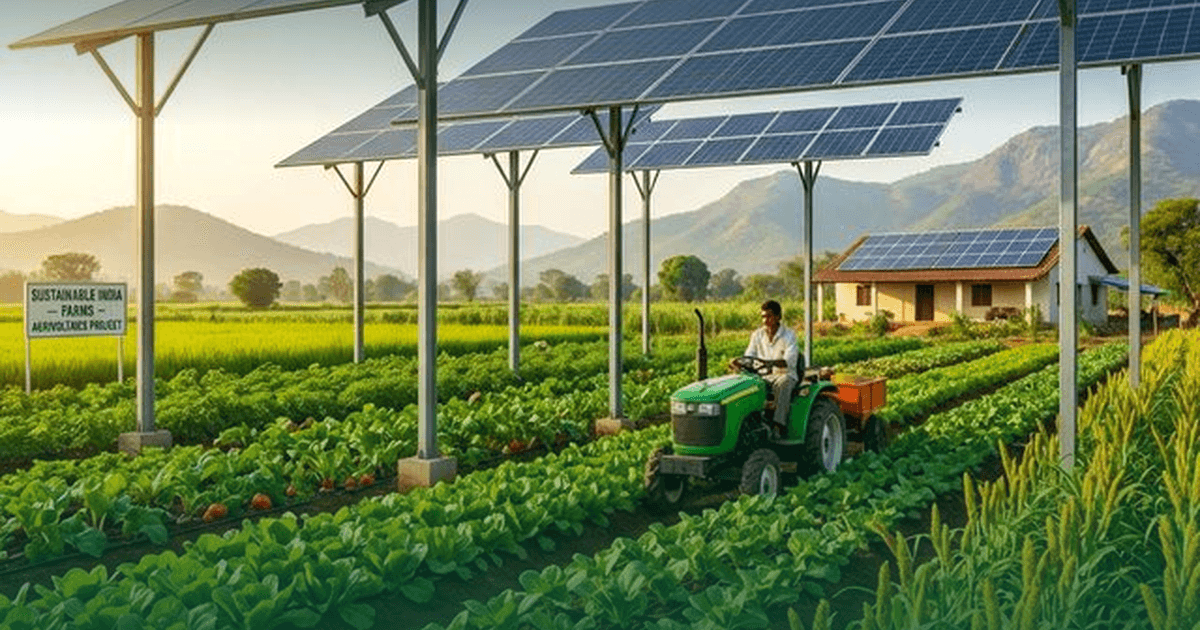
Unreliable rural grid power, severe voltage fluctuations that burn submersible motor windings, and sky-high diesel generator bills (₹90–₹95 per liter) pose chronic financial drains on Indian farmers. Solar energy transforms farms from energy consumers into self-sustaining power stations. By integrating solar water pumps, pulsed predator fences, decentralized micro-cold rooms, and grid feed-in systems, farmers secure uninterrupted daytime irrigation while unlocking passive power revenue.
1. Solar Agricultural Pumps (PM-KUSUM Components B & C)
Under the PM-KUSUM scheme, farmers install high-efficiency solar submersible or surface water pumping systems engineered for deep borewells and open farm ponds: | Pump Rating | Solar PV Array Required | Daily Water Discharge (Average 100 ft Head) | Ideal Farm Holding | |---|---|---|---| | 3 HP (AC/DC Submersible) | 3,000 Watt Peak (Wp) | 1,20,000 – 1,50,000 Liters / day | Up to 3.0 Acres (Drip/Sprinkler) | | 5 HP (AC/DC Submersible) | 4,800 – 5,000 Wp | 2,20,000 – 2,80,000 Liters / day | 3.0 to 7.0 Acres | | 7.5 HP (AC Submersible) | 7,500 Wp | 3,50,000 – 4,50,000 Liters / day | 7.0 to 12.0 Acres |
Key Technology Considerations: * VFD (Variable Frequency Drive) Inverter: Automatically ramps up pump speed during early morning sunrise and late afternoon hours, ensuring maximum daily water output even under mild cloud cover. * Monocrystalline vs. Polycrystalline Panels: Monocrystalline PERC panels deliver 21%–22% conversion efficiency, generating 15% more power on hot summer days compared to conventional polycrystalline panels. * Financial Subsidy: Under PM-KUSUM, the farmer contributes only 10% to 15% of benchmark costs, with the remainder co-funded by Central Financial Assistance (30%) and State Subsidies (up to 55%).
2. Solar Energized Farm Fencing (Zatka Machine)
Wild boars, nilgai (blue bulls), stray cattle, and monkeys destroy an estimated 15% to 25% of standing cash crops across India annually. Solar Energized Pulsed Fencing offers an effective, non-lethal, humane deterrent:
- How It Operates: A 40W solar panel charges a 12V deep-cycle battery. An electronic energizer (Zatka controller) converts DC battery power into sharp, high-voltage (8,000 to 10,000 Volts) pulses lasting only 1 millisecond at 1-second intervals. * Humane Defense: The brief pulse delivers an intense physiological shock that immediately repels intruding wildlife without causing physical injury, burns, or cardiac arrest to animals or humans. * Safety Mandate: Never connect farm fencing directly to 230V AC grid mains, which is illegal and constitutes a non-bailable criminal offense. Always utilize an energized, BIS-compliant solar controller with independent lightning arresters and triple-plate earthing.
3. Solar-Powered Micro Cold Storage Units
Post-harvest rotting of perishable fruits (tomatoes, strawberries, grapes, leafy vegetables) during peak harvesting gluts forces farmers into distress selling. * Farm-Gate Cold Rooms: Decentralized 5 MT to 10 MT walk-in cold rooms powered by 5 kW to 7.5 kW rooftop solar PV arrays maintain storage temperatures of 2°C to 8°C with 85% relative humidity. * Thermal Energy Storage (TES): Modern solar cold rooms incorporate phase-change material (PCM) thermal batteries that store cooling without requiring expensive lead-acid or lithium battery banks, providing up to 30 hours of continuous backup during rainy monsoons.
4. Financial ROI: Replacing Diesel Pumping with Solar
| Parameter | 5 HP Diesel Pump Operation | 5 HP Solar Pump (PM-KUSUM) | |---|---|---| | Capital Cost (Farmer Share) | ₹45,000 (Diesel engine + pump) | ₹38,000 (After 85% government subsidy) | | Annual Fuel / Energy Cost | ₹92,000 (1,000 liters diesel @ ₹92/liter) | ₹0 (Free daytime solar energy) | | Annual Maintenance | ₹8,000 (Engine oil, gaskets, overhauls) | ₹1,500 (Routine panel cleaning with water) | | 5-Year Cumulative Expenditure | ₹5,45,000 | ₹45,500 | | Net 5-Year Farmer Savings | — | ₹4,99,500 (Saves ~₹1 Lakh per year!) |
Frequently Asked Questions (FAQ)
Q1: How often do solar panels on a farm need to be cleaned? Dust, pollen, and dry soil particles settling on solar modules reduce power generation by 15% to 30%. In dusty rural agricultural environments, wipe solar panels with clean water and a soft microfiber mop once every 7 to 10 days, preferably in the early morning before panels heat up.
Q2: Can surplus electricity from a solar agricultural pump be sold back to the electric grid? Yes. Under PM-KUSUM Component C, farmers can solarize existing electric grid tubewells and install a bi-directional net meter. When the pump is not irrigating crops, surplus electricity is fed back to the local DISCOM at tariffs ranging from ₹2.50 to ₹3.50 per unit (kWh), earning passive monthly income.
Need Verified Farm Machinery on Rent?
Book modern tractors, harvesters, and implement attachments from verified local farm owners at fair daily rates.
Written by KhetiSetu Renewable Energy Team
Empowering Indian farmers with scientific agronomy, ICAR guidelines, and transparent digital tools.